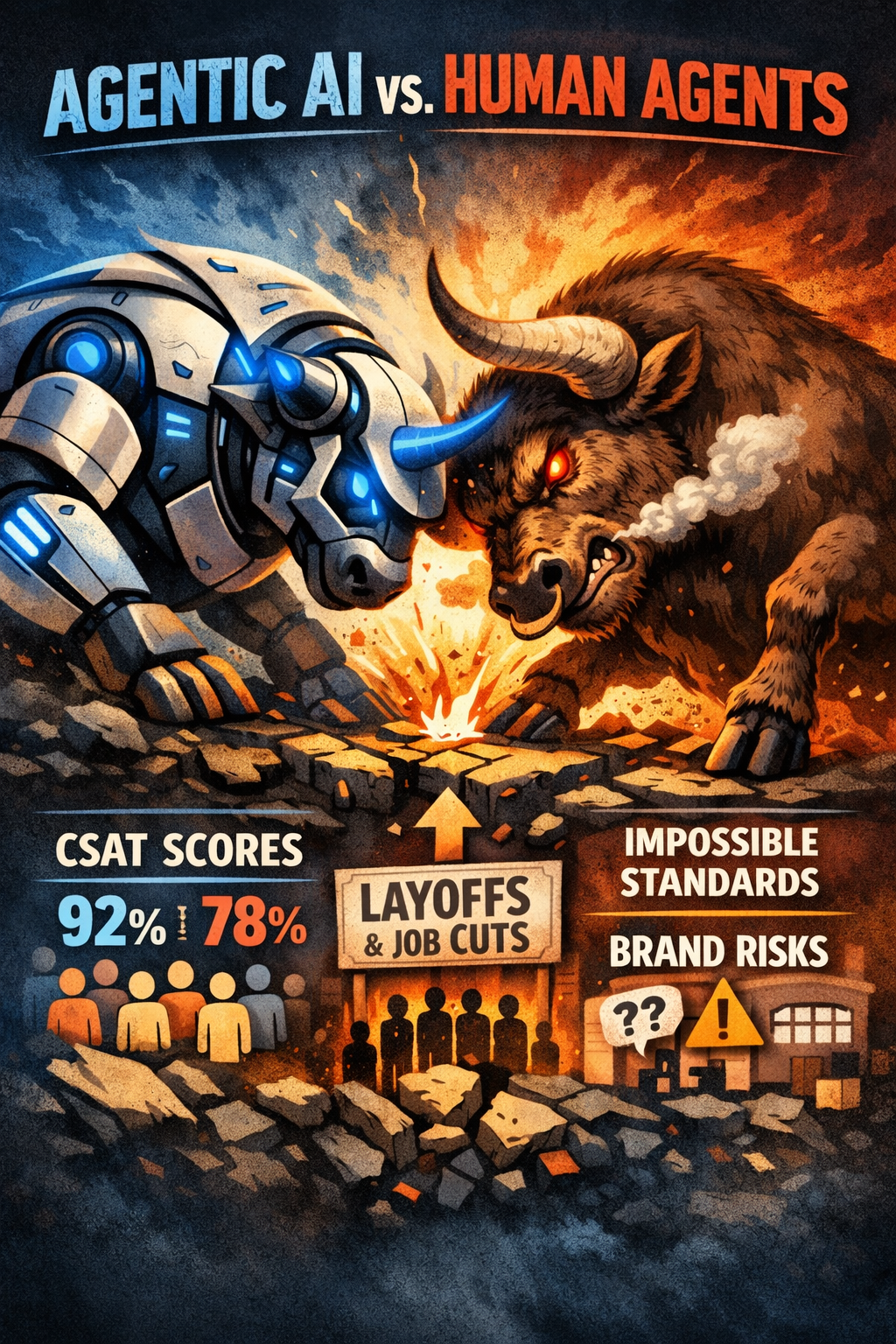
I recently came across a LinkedIn post from Forethought. Their infographic confidently declared that the future of phone support is agentic AI. The example scenario? A simple customer interaction disputing a credit card charge.
At first glance, it looks polished, even compelling. But once you unpack the assumptions behind the messaging, some uncomfortable questions and issues emerge.
CSAT Comparisons: Humans vs. LLMs — The Impossible Performance Standard
One of the headline claims was predictable:
“CSAT is up.”
Customer Satisfaction Score — traditionally a measure of human agent performance — is now being implicitly reassigned. We’re no longer comparing agent-to-agent. We’re comparing:
Human agents vs. Large Language Models
That shift matters.
An LLM trained on internal help documentation effectively has near-perfect recall. It doesn’t forget policies. It doesn’t have an off day. It doesn’t struggle with memory gaps mid-call.
Humans, by contrast:
- Get sick
- Get tired
- Forget edge-case procedures
- Experience cognitive overload
So what exactly are we measuring now?
This quietly drives the formation of another dynamic:
Human agents are being benchmarked against AI systems that:
- Have instant recall
- Never fatigue
- Maintain perfect tonal consistency
- Scale infinitely
This creates an asymmetry:
Humans are judged against non-human capabilities.
No matter how skilled, no human can outperform an LLM on retrieval speed or documentation recall. Yet performance expectations creep upward anyway.
The result?
- Increased pressure
- Lower morale
- Higher burnout
- Eventual justification for replacement
“Reduced Agent Workload” — And What That Really Means
Another celebrated metric:
“Agent workload reduced.”
On paper, that sounds beneficial. In practice, it often translates to:
“Do more with fewer people.”
Let’s be candid.
Labor is one of the largest controllable expenses on a company’s balance sheet. When executives see automation reducing workload, the next step is rarely philosophical — it’s financial.
- Fewer calls handled by humans
- Fewer agents required
- Headcount reductions
There’s a persistent optimism that displaced workers will be “retrained” or “repurposed.” Historically, that’s the exception, not the rule.
Cost reduction initiatives don’t typically evolve into large-scale reskilling programs. They evolve into layoffs.
The Societal Impact No One Wants to Discuss
Call center work isn’t glamorous. But it remains one of the most accessible entry points into:
- Full-time employment
- Benefits eligibility
- Stable income
If agentic AI eliminates 50–60% of these roles:
Where do those workers go?
Many are:
- Under-educated
- Career-transitioning
- Dependent on structured employment pathways
We’re not just automating tasks — we’re compressing an employment sector.
And this transition is happening with remarkably little serious public discussion about downstream societal effects.
The Cost-Savings Driver
Let’s not pretend motivation is ambiguous.
Organizations aren’t adopting agentic AI primarily because it’s “innovative” or “exciting.”
They’re adopting it because:
It reduces operating expense
Yes, AI can be “better” in specific dimensions:
- Recall accuracy
- Consistency
- Availability
But “better” is often inseparable from “cheaper.”
Closing Thought
The vendor story is familiar:
- Higher CSAT
- Lower workload
- Better efficiency
- Seamless automation
The omitted story:
- Workforce displacement
- Performance asymmetry
If we’re going to redesign entire employment categories and redefine human performance expectations, we should at least acknowledge the full equation — not just the efficiency metrics.