Nearly every style of taijiquan practiced today traces its roots to a single village in Henan Province and to one family that kept its fighting art to itself for generations. This page follows that lineage from its origins in Chen Village, through the decision that carried the art outside the family, to the major styles that grew from it and to the modern Hunyuan system of Feng Zhiqiang.
Origins in Chen Village
Chen style comes from Chenjiagou (Chen Family Village) in Wen County, Henan. The village was founded by Chen Bu, who migrated from Shanxi Province in the early Ming dynasty, around 1372. The Chens developed a reputation as fighters early on, but the art we now call taijiquan is credited to a later descendant.
Other origin stories exist. The most famous credits the Daoist immortal Zhang Sanfeng with creating taiji after watching a crane fight a snake, and another names a figure called Jiang Fa as Chen Wangting’s teacher. These are cherished parts of taiji culture, but most historians trace the art to Chen Village itself.
The Chen Family Line
Chen Wangting (c. 1580–1660), 9th generation
Chen Wangting is traditionally credited as the creator of taijiquan. He served as a militia officer and, in retirement, blended his family’s boxing with material from General Qi Jiguang’s classic manual of 32 long boxing postures. He also drew on yin and yang theory, Daoist breathing practices and the meridian theory of Chinese medicine. He is said to have created several routines, including early taiji sets, a long fist form and cannon fist.
Chen Changxing (1771–1853), 14th generation
Chen Changxing learned from his father, Chen Bingwang, and made his living for a time as an armed caravan escort protecting goods moving through Shandong and the surrounding provinces. He stood and sat so upright and still that the village nicknamed him “Mr. Ancestral Tablet,” after the carved memorial plaques kept in family shrines.
His technical legacy was consolidation. By his time the routines handed down from Chen Wangting had multiplied, and he distilled them into the two sets that became the core of the system:
- Yilu (first routine): mostly slow and soft, built on silk reeling, with occasional explosive releases of power.
- Erlu, or Paochui (cannon fist): fast, hard and explosive, with jumps, stamps and rapid fajin.
Together these became Laojia, the old frame. Nearly everything later in the family line builds on them.
His other legacy came from breaking tradition. Chen boxing was normally kept inside the family, but Changxing accepted an outsider named Yang Luchan. That single decision is the reason taiji spread across China and eventually the world.
Chen Youben, 14th generation
A contemporary of Changxing, Chen Youben is credited with developing Xiaojia, the small frame, which uses tighter and more internalized circles than Laojia.
Chen Qingping (1795–1868), 15th generation
A student of Chen Youben, Chen Qingping married into the nearby village of Zhaobao and taught there. His teaching gave rise to the Zhaobao branch and helped shape Wu (Hao) style through his student Wu Yuxiang.
Chen Xin (1849–1929), 16th generation
Chen Xin wrote Illustrated Explanation of Chen Family Taijiquan, the most important theoretical text of the lineage. It is best known for its detailed treatment of silk reeling energy.
Chen Fake (1887–1957), 17th generation
Chen Fake descended from Chen Changxing through Changxing’s son Chen Gengyun and grandson Chen Yanxi, who was Fake’s father. In 1928 he moved to Beijing, where his skill as a fighter put Chen style on the national map for the first time. The way he performed the forms in his later years became the basis for Xinjia, the new frame.
Chen Zhaopi (1893–1972) and Chen Zhaokui (1928–1981), 18th generation
War and famine in the first half of the twentieth century nearly ended training in Chen Village. Chen Zhaopi, Chen Fake’s nephew, returned to the village in 1958 to revive it. Chen Zhaokui, Chen Fake’s son, also taught in the village and helped codify Xinjia.
The Four Tigers, 19th generation
Chen Zhaopi and Chen Zhaokui trained a generation of students known in Chinese as the Si Jingang (the four guardian warriors) and in English as the Four Tigers: Chen Xiaowang, Chen Zhenglei, Wang Xi’an and Zhu Tiancai. Wang Xi’an and Zhu Tiancai grew up in Chen Village but do not carry the Chen surname. From the 1980s on, these four did more than anyone to carry Chen style around the world, and their students and family members continue that work today.
The Frames of Chen Style
Within the Chen family itself, several versions of the forms developed:
- Laojia (old frame): Chen Changxing’s Yilu and Erlu, the foundation of the system.
- Xiaojia (small frame): associated with Chen Youben, emphasizing compact, internal circles.
- Xinjia (new frame): based on Chen Fake’s later teaching in Beijing, with more pronounced spiraling and more visible silk reeling.
Across all of them, the defining principles are chansi jin (silk reeling energy), spiral force driven from the dantian, alternation between fast and slow and between hard and soft, and fajin, the explosive release of power. The eight energies (peng, lu, ji, an, cai, lie, zhou and kao) form the technical vocabulary, with peng treated as the foundation of the rest.
How Taiji Left the Family: The Branch Styles
Yang style
Yang Luchan (1799–1872) came from Yongnian in Hebei Province. A popular story says he worked as a servant in the Chen household and secretly watched the family train at night until Chen Changxing noticed his talent. More sober accounts suggest he was referred through a Chen family member who ran a pharmacy in Yongnian. Either way, he trained with Changxing for many years, then took the art to Beijing, where he taught members of the imperial court and earned the nickname “Yang the Invincible.”
His sons Yang Banhou and Yang Jianhou carried the art forward, and his grandson Yang Chengfu (1883–1936) standardized the large frame form most people picture when they think of taiji today: slow, even, expansive movement with the fajin and stamping of Chen style smoothed away. Yang style is the most widely practiced style in the world, and most other styles descend from it.
Wu (Hao) style
Wu Yuxiang (1812–1880), also from Yongnian, first learned from Yang Luchan and later traveled to Zhaobao to study with Chen Qingping. The style he developed is compact, with small, precise movements and a strong emphasis on internal structure. It passed to his nephew Li Yiyu and then to Hao Weizhen (1849–1920), whose family name is often used for the style to distinguish it from the other Wu style below. Wu Yuxiang’s circle is also credited with preserving several of the classic taiji texts.
Wu (Jianquan) style
This is a separate Wu style, written with a different Chinese character. Quan You (1834–1902), a Manchu officer in the imperial guard, studied with Yang Luchan and Yang Banhou in Beijing. His son, Wu Jianquan (1870–1942), refined the teaching into its own style, known for a smaller frame, a slight forward lean of the body kept in a straight line and parallel footwork in many postures. It is the second most popular style after Yang.
Sun style
Sun Lutang (1860–1933) was already a master of Xingyiquan and Baguazhang when he learned taiji from Hao Weizhen. He blended all three arts into a style known for its high stances, lively follow steps (one foot following the other) and opening and closing hand movements. Sun Lutang also wrote influential books on the internal martial arts.
Zhaobao
The Zhaobao branch developed in the village of Zhaobao, a few miles from Chen Village, largely through Chen Qingping’s teaching. Its practitioners maintain their own lineage accounts, and the relationship between Zhaobao and Chen style remains a subject of debate.
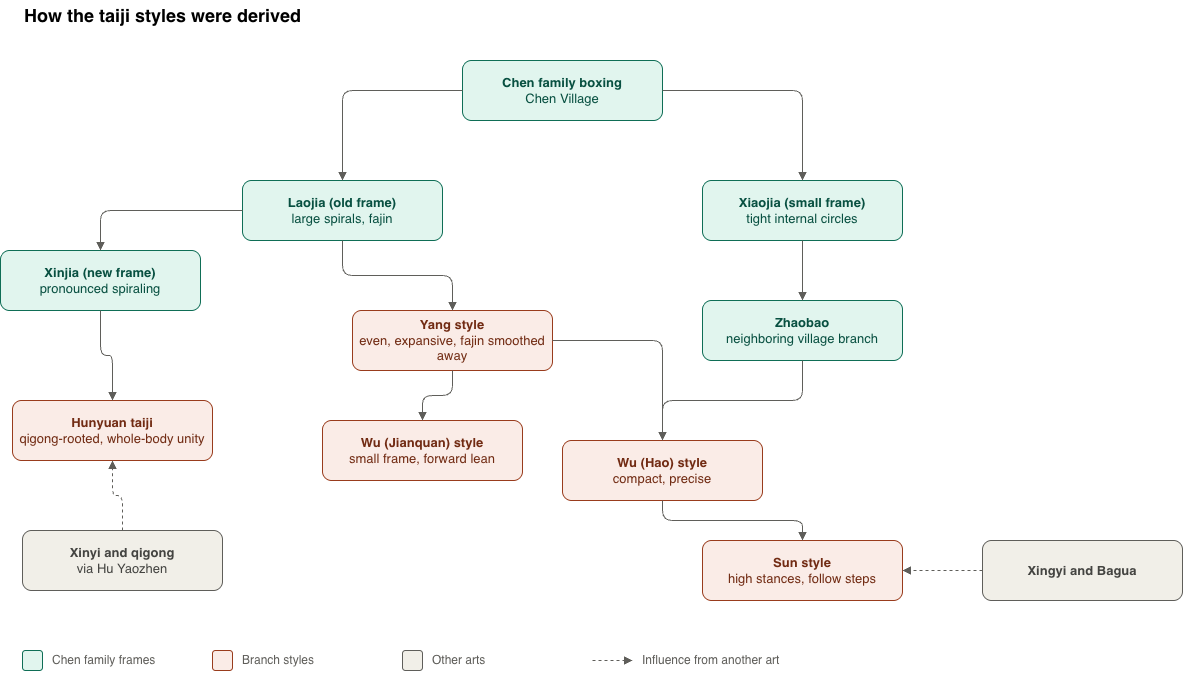
How the Styles Were Derived
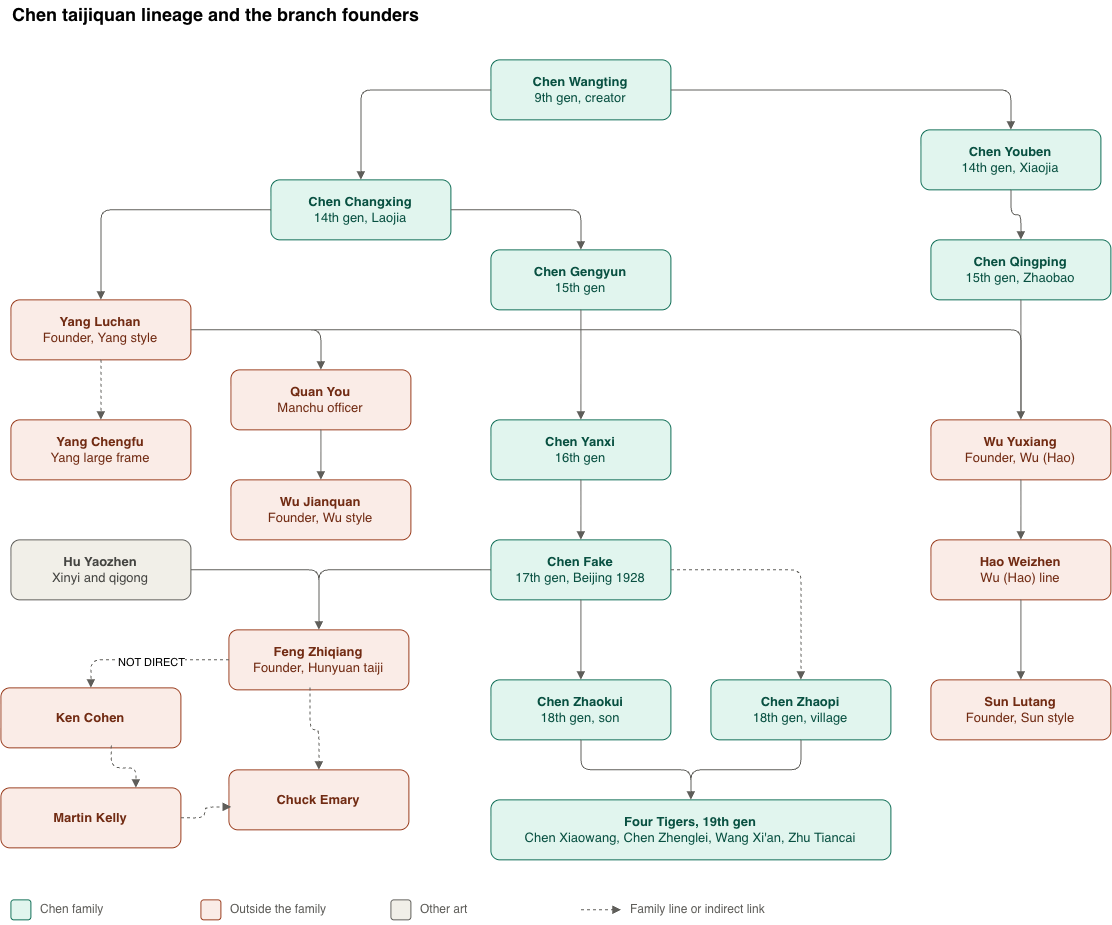
The lineage chart at the bottom of this page follows people. The diagram below follows the styles themselves: which frame each one grew from, what other arts fed into it and the trait that most sets it apart.
Chen Shi Xinyi Hunyuan Taijiquan
Hu Yaozhen (1879–1973)
Hu Yaozhen was a master of Xinyi and qigong rather than taiji. He was one of the early teachers of Feng Zhiqiang and introduced him to Chen Fake. His emphasis on internal cultivation and qigong became one half of the system Feng would later create.
Feng Zhiqiang (1928–2012)
Feng Zhiqiang was born in Hebei Province and trained in Tongbeiquan and other external styles as a young man. Around 1951 he began studying with Hu Yaozhen, who introduced him to Chen Fake. Feng trained with Chen Fake until Chen’s death in 1957 and became known for his push hands and practical fighting skill, all while working for years as an electrician in a Beijing factory. He belongs to the 18th generation, alongside Chen Zhaokui and Chen Zhaopi, although he was not a Chen family member.
Feng created Chen Shi Xinyi Hunyuan Taijiquan, which combines Chen Fake’s Xinjia with the Xinyi principles and internal work he learned from Hu Yaozhen. He also led the Beijing Chen Style Taijiquan Research Association, which made him a central figure in Chen style’s development outside Chen Village.
What “Hunyuan” means
The name reads roughly as “Chen style heart-mind, primordial unity taijiquan.” The word hunyuan comes from Daoist cosmology. Hun means blended or undifferentiated, and yuan means origin. Together they describe the single, undivided state of the universe before it separated into yin and yang. In practice, Feng used the term to describe the whole body moving as one unified sphere of energy, inside and outside working together, with the spiraling of silk reeling as its outward expression.
The Hunyuan curriculum
The system is built in layers, each resting on the one beneath it:
- Hunyuan standing: settling the body into its structure and establishing the dantian as the center of all movement.
- Hunyuan qigong (primordial qigong): slow opening and closing, dantian rotation, rising and sinking and circling, each led by intent rather than by the limbs.
- Silk reeling: spiral movement driven from the dantian, the bridge between internal cultivation and martial mechanics.
- Forms: the 24 and 48 posture Hunyuan forms, along with the Chen routines Feng retained.
- Push hands and weapons: testing and extending whole-body unity under pressure and beyond the body.
In this lineage the qigong is not a warmup. It is the root that everything else grows from.
Lineage at a Glance
Taiji Today
In 2020 UNESCO added taijiquan to its list of the Intangible Cultural Heritage of Humanity, recognizing Chen Village as its birthplace. From a single family’s guarded art, taiji has become one of the most widely practiced martial and health disciplines in the world, and every major style still carries some trace of the spiraling, whole-body movement first cultivated in Chenjiagou.