A few weeks ago I got together with my martial arts instructor and longtime friend, Master Martin Kelly. We meet up like this from time to time to get some training in, shoot a few videos, and catch up. Somewhere in the middle of it, Martin floated an idea: let’s do a Norwegian 4×4.
I had no idea what that was.
So I did what anyone does. I looked it up. And it turned out to be a lot more interesting than the name let on. It’s a deceptively simple little protocol with a surprisingly deep bench of science behind it, and a following that runs from Olympic coaches to cardiac rehab clinics. Here’s what I found out before we got into it.
So what is a Norwegian 4×4?
At its core, it’s about as simple as a workout gets to describe: four hard four-minute efforts, with three minutes of easy recovery between each one. That’s the whole thing. Four by four.
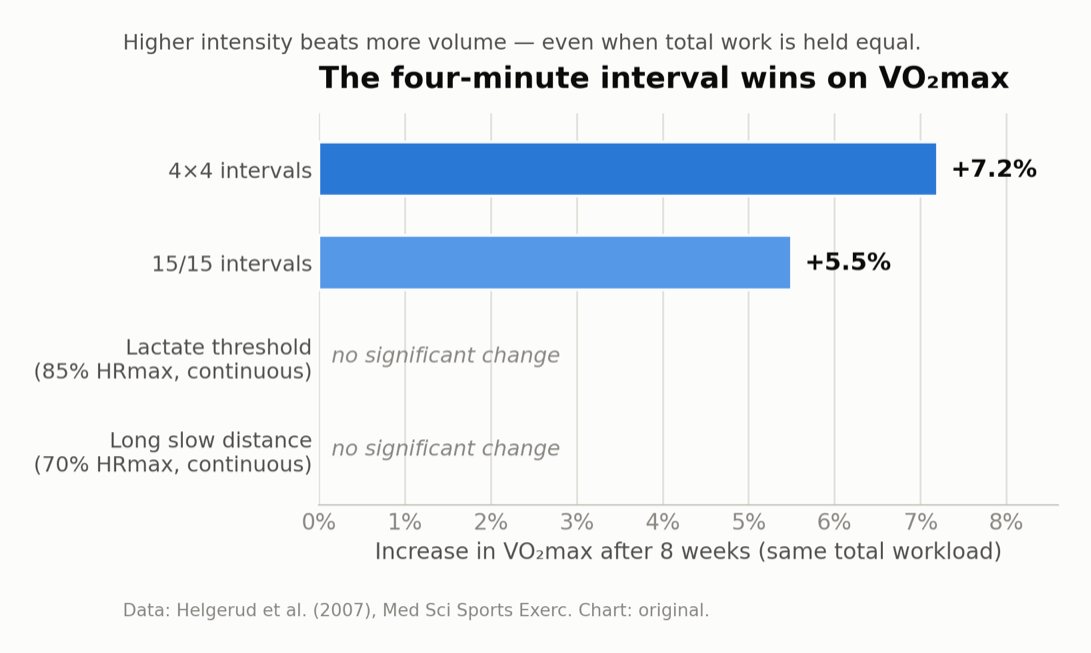
Spelled out, a full session looks like this:
- A warm-up of about ten easy minutes to get the engine warm.
- Four intervals of four minutes each, run at 85–95% of your maximum heart rate. Hard, but not an all-out sprint. Think “I can do this, but I’d really rather not talk right now.”
- Three minutes of active recovery between intervals: you keep moving, just easy, letting your system reset for the next round.
- A cool-down of about five minutes.
All in, you’re looking at roughly 35–40 minutes, with about 16 of those minutes being genuinely hard work. You can do it running, cycling, rowing, on an incline treadmill, uphill, anything that lets you hold a high, steady heart rate. Most people who use it do it two or three times a week.
It’s not a “traditional” gym HIIT circuit with burpees and dumbbells. It’s a cardiovascular protocol, and every part of it is built around one very specific goal.
Where it comes from
The 4×4 isn’t a trend somebody invented on social media. It came out of the lab of two exercise physiologists, Jan Helgerud and Jan Hoff, at the Norwegian University of Science and Technology in Trondheim, hence “Norwegian.” Their group has spent years publishing peer-reviewed research on it, and it eventually made its way into cardiac rehabilitation programs for heart patients. That’s a big part of why I found it so interesting: this is a workout with a paper trail.
The whole point: VO₂max
Everything about the 4×4 is engineered to do one thing: push you close to your VO₂max, the maximum amount of oxygen your body can actually use, and keep you there.
That matters because VO₂max is one of the single best predictors of cardiovascular health and, frankly, of how long you’re going to live. It also quietly declines about 1% a year as you age. So training that moves the needle on it isn’t just about being fitter this month. It’s one of the more legitimate “longevity” levers out there.
Here’s the clever part, and the reason the intervals are four minutes instead of thirty seconds: it takes a couple of minutes of hard effort for your heart rate and oxygen use to actually climb up into that top zone. Short bursts end before you get there. Four minutes is long enough to reach the top and then hold it, banking real time near your ceiling. And the three-minute recoveries are deliberately not too long, just enough to clear the burn and let you go again, but not so much that you cool all the way down.
Do it right and you spend the bulk of those 16 working minutes parked up near 90% of your max heart rate. Over weeks, your heart literally adapts, pumping more blood per beat, and your VO₂max climbs.
How it stacks up against “regular” HIIT
When most people say HIIT, they picture short, savage bursts: Tabata (20 seconds on, 10 off), all-out 30-second sprints, that kind of thing. The Norwegian 4×4 is a different animal, and the difference comes down to one thing: length.
Traditional HIIT is short, explosive, and anaerobic: you go all-out and you’re done in seconds. The 4×4 is long, controlled, and aerobic. Hard, but paced so you can sustain and repeat it. That one distinction changes what each one is actually good for.
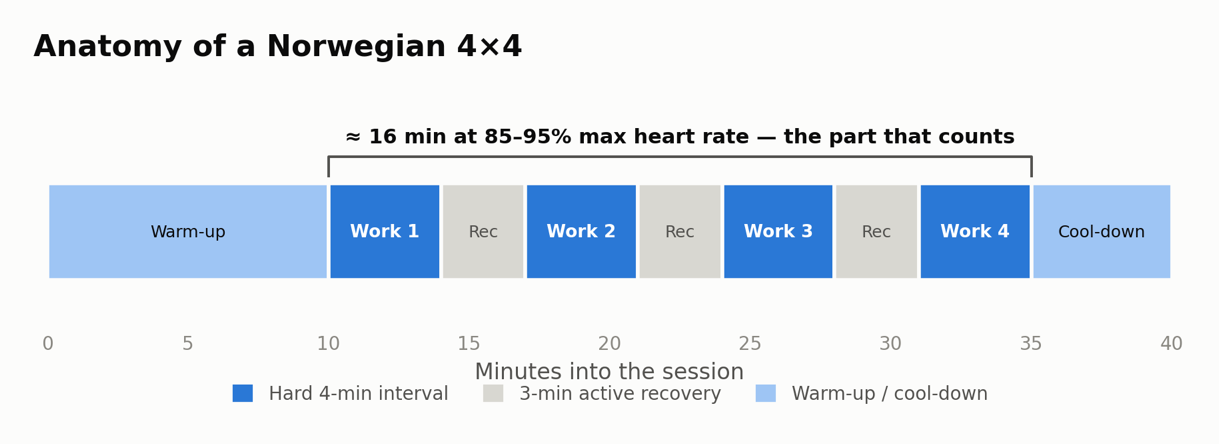
For raising VO₂max specifically, the 4×4 has the stronger track record. In the classic study, four minutes of interval work beat both moderate steady cardio and shorter intervals for improving VO₂max, and it did it even when the total workload was matched. The longer bouts simply buy more time in the zone that drives the adaptation. Newer research has even put it ahead of all-out sprint intervals for building aerobic capacity.
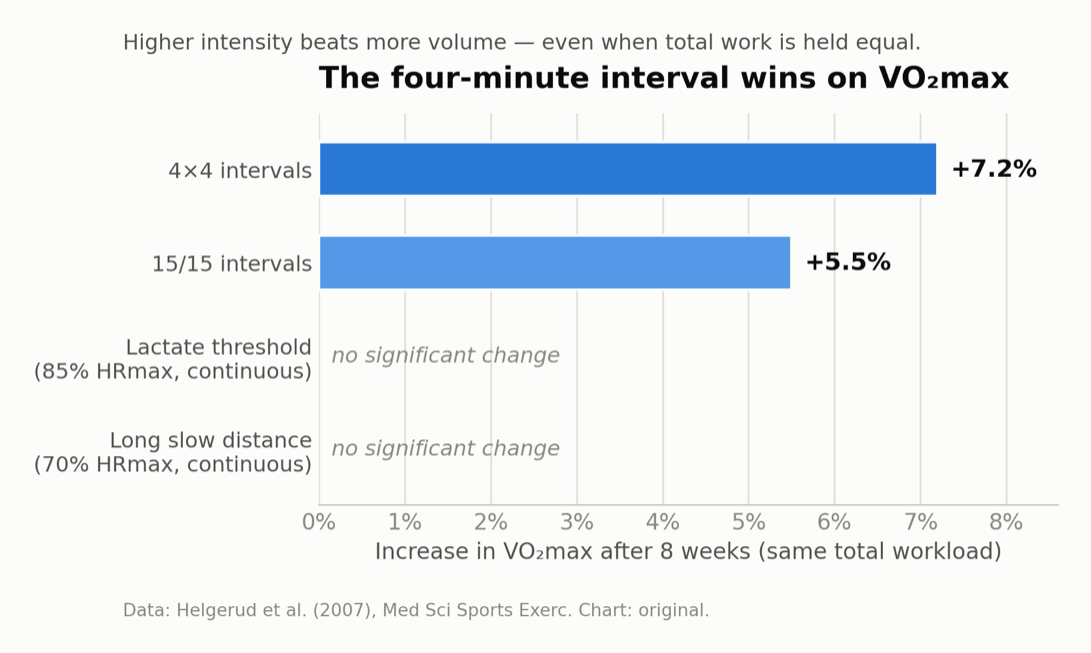
Data: Helgerud, J., Høydal, K., Wang, E., Karlsen, T., Berg, P., Bjerkaas, M., Simonsen, T., Helgesen, C., Hjorth, N., Bach, R., & Hoff, J. (2007). Aerobic high-intensity intervals improve VO₂max more than moderate training. Medicine & Science in Sports & Exercise, 39(4), 665–671. https://doi.org/10.1249/mss.0b013e3180304570 . Chart built from the reported figures.
Short HIIT still has its place. It’s faster to knock out and it builds sprint power and anaerobic capacity in ways the 4×4 doesn’t. But if the goal is a bigger aerobic engine and a healthier heart, the 4×4 is hard to beat. And because it’s paced by heart rate rather than run to total failure, it’s forgiving enough that clinicians hand it to recovering heart patients, which tells you something about how sustainable it is compared to sprinting yourself into the ground.
So that’s what Martin was proposing. Sixteen minutes of hard breathing, a protocol with real science behind it, and a payoff that reaches all the way to how long you live. Naturally, I said yes.
How we did ours: Two Dragons at Play
Here’s the thing, though: Martin and I didn’t do our 4×4 on a treadmill or a stationary bike. We did it sparring.
And I’ll be honest: I was completely gassed. It was exhausting. The one bit of good news was that I had a slight home-field advantage: I live at 9,200 feet, right where we were training. So Master Kelly was every bit as gassed as I was; the difference being that in his case it was because he isn’t used to working at this altitude.
The method we started with is a training drill we call Two Dragons at Play, which comes out of the Baguazhang system. The setup is simple: you face your opponent, turn to the side with your guard up, and the two of you begin to circle each other. Then, on the cue, you immediately go into combat.
What makes it such a natural fit for a 4×4 is that the rules are deliberately open. Just about anything goes. Any standing grappling technique, any joint lock, any throw or takedown is a perfectly legal technique. Strikes aren’t thrown for real. They’re simulated, so you mark one by placing your hand on your opponent’s face, or into the ribs, to show a strike that would have landed. From there it can flow into throws, takedowns, and grappling all the way to submission. The result is something that feels a lot like a real fight: open-ended, unpredictable, and physically relentless.
And that’s exactly the point. Four minutes of that is a very different four minutes than four minutes on a rowing machine.
Why it fits martial arts so well
And honestly, that’s what made the whole thing so interesting to me. This kind of training feels genuinely apropos for martial arts in a way that most conditioning work simply doesn’t.
Think about how a fight is actually structured. A professional MMA bout is typically three rounds of five minutes each (amateurs run a little differently), but the shape is the same: sustained hard rounds with recovery in between. That’s the 4×4’s rhythm almost exactly. The protocol maps onto the real demands of fighting far better than steady-state cardio ever could.
And when you spar the way we were sparring, you’re not just running your engine. You’re constantly making contact, moving, throwing, falling, rolling. The whole time, you’re trying to hold two things together at once: high skill and technique on one side, and physical fitness on the other. That’s the genuinely hard part, and it’s exactly what the 4×4 trains, because it forces you to manage yourself.
Picture it. If you went out and blew everything on the first four-minute round, you’d both be exhausted and done, and there’s nothing left to work with. So you have to find the balance: pushing the intensity, while staying aware that the intensity itself produces physiological responses that start to degrade your ability to perform. When you’re truly gassed, you can’t feel techniques anymore. You can’t respond to them. Your body just stops answering.
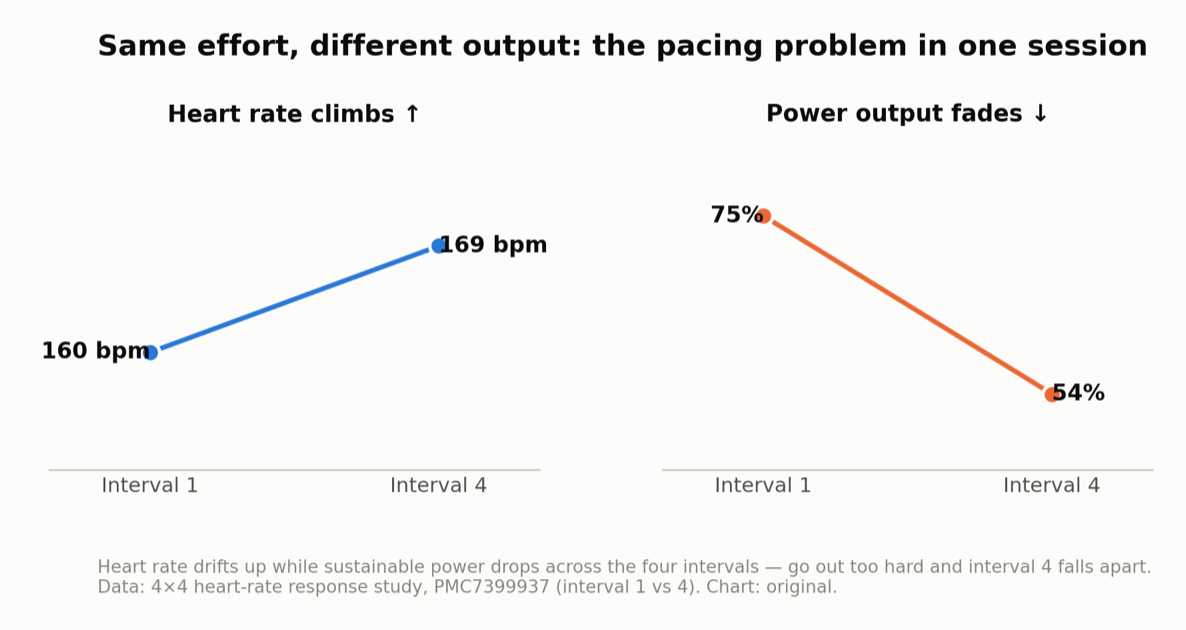
Data (interval 1 vs. interval 4): Acala, J.J., Roche-Willis, D., & Astorino, T.A. (2020). Characterizing the heart rate response to the 4 × 4 interval exercise protocol. International Journal of Environmental Research and Public Health, 17(14), 5103. https://doi.org/10.3390/ijerph17145103 . Chart built from the reported figures.
Learning to work right at that edge, hard enough to build the engine but controlled enough to keep your technique intact, turned out to be an extremely powerful approach to periodic training.
Working on my own base
Which brings me to the next logical step: my own base level of conditioning.
For me, that means the rowing machine (I use a Concept2 Dynamic), and I’ve started running the 4×4 on it myself. Right now I’m in what I’d call “completion mode.” The only goal at this stage is to get through the work: four four-minute rounds with three minutes of rest in between. I’m not chasing numbers yet. I’m just finishing the rounds so I can understand my pacing and get a feel for how the effort spreads across the session.
The next step will be tightening that up: actually driving up to that 90% max heart rate and holding it there through each four-minute row. To keep an eye on it, I use ErgZone, which ties into my Apple Watch so I can see exactly where I am from a heart-zone perspective in real time.
Once I’ve logged some real sessions at that intensity, I’ll write a follow-on article with the actual data: pacing, heart-rate zones, and how it all progresses. Stay tuned for that one.