Where Tai Chi Earns Its Reputation
There is a common misconception about Tai Chi and the health benefits it produces. Some of you are going to roll your eyes at this point, before you even read the rest of the article. That doesn’t change the fact that the way most people practice Tai Chi will not produce the health benefits they’re after.
Tai Chi is widely characterized as a gentle, great way to get into good health, and I want to say up front that in general I agree with that.
Imagine a person who just went through chemotherapy. They are exceptionally weak, and Tai Chi is a great place to start building strength from. Or maybe someone broke their hip and has been bedridden for a while, and now they’re trying to get back into shape. Or maybe it’s an elderly person who hasn’t done much activity at all and wants to use Tai Chi to start building strength and as a general way to begin working on flexibility.
In those cases I believe Tai Chi is a great place to start. It’s good for your health and you get immediate health benefits.
Most People Aren’t Starting From Zero
But most people are not in that place. Most people are moderately active. Maybe they’re middle-aged, somewhere between 40 and 60, and looking to get more active than they have been. They’re not grossly overweight. This is the typical profile of the people you see in Tai Chi, and they come for the gentle health movements. Maybe they’ve had a knee injury or a shoulder injury, and they don’t want to exacerbate it through weightlifting or Pilates or those sorts of things.
Tai Chi Without the Martial Is Just Dance
So most people who learn Tai Chi learn it for health. The problem is that Tai Chi is a martial art. The health benefits come out of Tai Chi primarily because of its martial roots, not the other way around. If you’re not learning the martial part of Tai Chi, you have essentially stripped yourself of the health benefits.
Let me give you a concrete example.
Tai Chi without the martial side is nothing more than dance. I’m not throwing shade on dancers here. Dancers are exceptionally fit. Jump on the internet and watch some of them: they’re extremely fit and extremely flexible. But Tai Chi is not that. Because of the slow way you practice it, you get neither aerobic nor anaerobic benefits from Tai Chi.
On top of that, most forms of Tai Chi have been stripped of their more athletic movements. There are a handful, like Snake Creeps Down the Vine, that require flexibility and strength, but the vast majority of the postures in forms like the 24-posture simplified and combined form are devoid of extreme movements. You don’t get the muscular workout you would get if you were jumping or working in very deep stances.
So let’s go back to the dancing analogy.
Imagine you’ve taken a dance class and decided you want to learn a particular move. It’s a partner drill, a series of interactions with your partner, and at some point your partner is going to leap into your arms, you’re going to lift them over your head, spin them around and set them down. You can find all kinds of dance techniques like this on the internet.
So here we are. You practice this form day in and day out. You’ve stretched and you’ve got this thing nailed. Your partner has it nailed too. You’ve even done light interaction where they leap and you don’t catch them, just to work the timing. All well and good.
Then comes the day you try it with your partner. Your partner leaps toward you, you go to lift, and partway through the lift you both crash horribly to the floor.
Why and how did that happen? It happened because lifting someone requires strength, even if they’re leaping. Not only does it require distance, angling and timing, it requires a kind of whole-body strength. Most people, men or women, are not strong enough to lift a 120-pound person who is flying through the air over their head. It takes core strength and leg strength.
That all makes sense. You’d say, of course, the dancers are doing calisthenics and lifting weights to build that strength, which is exactly what you would expect.
But in the Tai Chi world you never hear that. You hear that you can just practice the form and you’ll become naturally healthy and naturally strong. There’s no “let’s go lift weights.” There’s no impact training. Tai Chi came from martial arts, and in martial arts you have to hit things. Hitting things changes your bone density. There are throws in Tai Chi, so you have to learn to fall, which again means bone density, safety and balance. In most Tai Chi schools none of that is ever a practice. We’re just going to do this slow form over and over and become naturally healthy. It’s a complete fallacy.
Intention Is What Works the Muscle
Set the conditioning aside for a moment, because even the form itself loses its value without martial intention. What I mean by intention is that there are places in the form where you need to know what the technique requires. If I’m going to do this technique right here, I need to activate my quadriceps. Equal and opposite force: that’s just physics. If I’m not activating my quadriceps, I’m not going to be able to actually do the move, nor will I get the health benefit, because I’m not innervating those muscles.
Qi Charlatans and Yin-Yang Excuses
The next thing I would really criticize is a trend you see across the entire martial arts industry, but particularly, I think, in the internal martial arts. I see two different things here. The first is what I call the qi charlatans. The second is the people who cloak the terminology in metaphysical terms, drawn from the I Ching and things like that.
Let’s talk about qi first. I believe that qi exists. Is it some weird metaphysical force that washes through your body? That is not my belief. I believe it’s an electromechanical force, but that’s just my belief.

What you’ll typically see is people doing the form and not accruing these health benefits. They’ve been taking classes, and they’re not losing weight. They’re not getting the physical benefits they thought Tai Chi was going to bring them. So immediately the instructors start in, and this is what I mean by the qi charlatans: “Well, you’re not circulating your qi properly.” And so we’re going to drag out your lessons for another year or two while we help you work through your qi circulation. All the while, you’re still not getting in any better shape.
The next group are the instructors who cloak your training in the I Ching, and again, this is yin and yang. You’ve been training for six months or a year and you’ve plateaued. Now it’s, “Well, that’s because you don’t have the proper balance of yin and yang.”
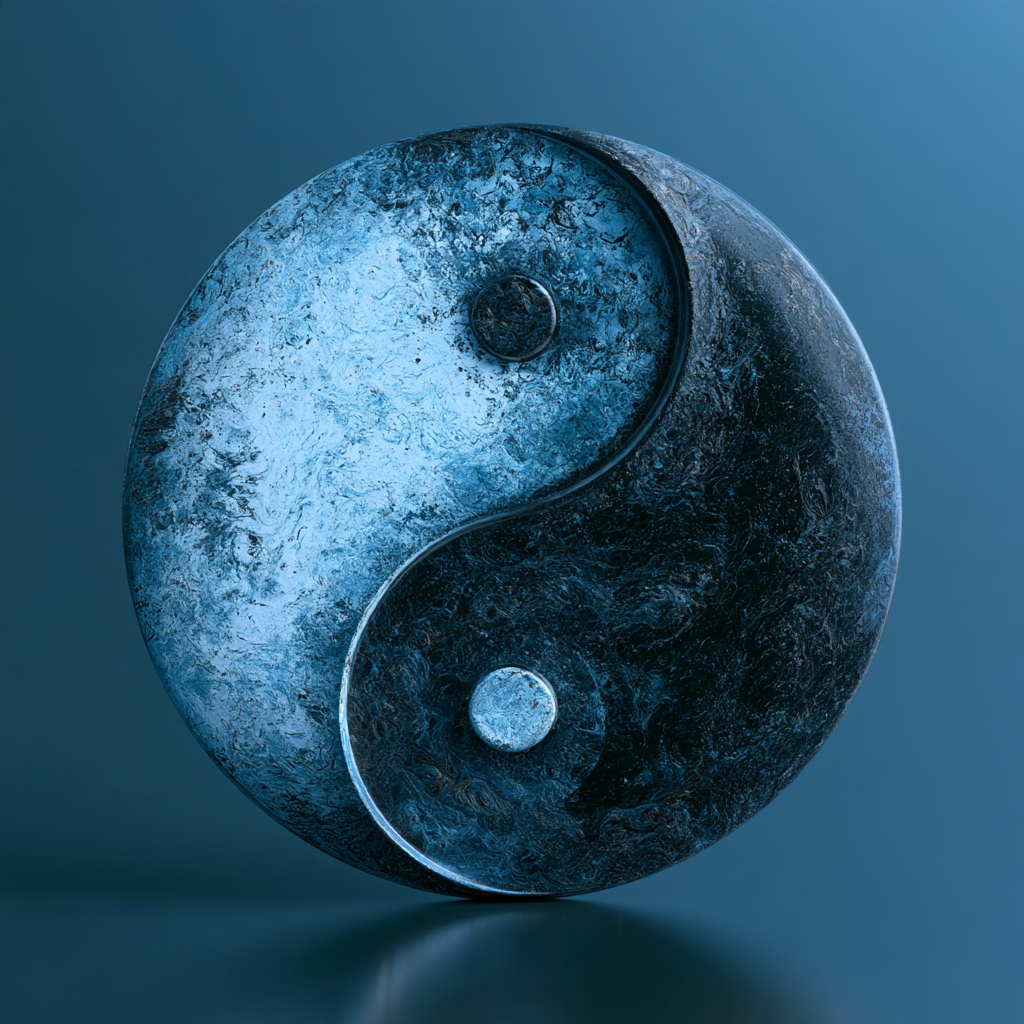
This is just nonsense. Yin and yang are simply opposites. Look at the Tai Chi symbol. You have yin and yang as opposites, but within each there is a dot of the other, a white dot in the black and a black dot in the white. That means there is no pure yin and no pure yang. They exist together. So the idea that you don’t have the right balance of yin and yang, and that it’s affecting your health practice, is utter nonsense. To raise your arm, some muscles are activated and tight while others are relaxed. That is a simple explanation of yin and yang.
These instructors drag their students through nonsensical explanations to keep them coming back, when in fact the solution to improving their health is to start doing the martial practice that goes with a Tai Chi practice.
You Don’t Have to Learn to Fight
So when I say the martial aspects, the question becomes: does everybody need to learn to fight? If I’m a 60-year-old woman and I’ve had a broken femur from a running accident, do I have to go learn to fight in order to get the health benefits?
Absolutely not. But there are things we can do in a martial sense to improve your health while you’re doing those forms. We can do the forms in a way that improves the health benefits. We will do martial drills that force you to innervate the muscles in your legs, so that you understand the feeling. Then when you’re doing the form, you can say, “When I’m in this particular posture, my legs should feel this way.” Oftentimes the only way to get that feeling is through a drill that involves some sort of martial technique.
A Longer Form Won’t Fix a Plateau
Another thing you may see: you’ve been doing, say, the 24-posture form for a certain amount of time and your health has plateaued. The instructor says, “Well, now you need to learn the 48-posture form, or the 156-posture form. That’s going to get you over the plateau.”
I suppose on some level that’s true. Some forms take 20 minutes to do and others might take an hour. The point is that the standard answer to a plateau is to double the amount of time you’re practicing. Generally speaking, more exercise, to a point, is better than less exercise, if we exclude things like HIIT. But doubling your practice time may or may not actually give you the benefits you were expecting.
But in this case, the form isn’t the problem. Learning another form where you’re doing the same thing isn’t going to get you over your health plateau. That’s the real problem. You’re going to have to do something different. You’re going to have to do bag work. Again, that’s something you don’t see very often from Tai Chi instructors: “We’re going to get our MMA gloves and hit the bag.” That produces a health benefit. Practicing in the air, you don’t get the same benefit.
Find an Instructor Rooted in the Martial
In general, if you’re in that place where you’re using Tai Chi for health and you’ve plateaued, look at whether your instructor knows the martial techniques. When I say martial techniques, I mean that most of these postures are multifaceted. A technique like Single Whip can be a throw, it can be a strike, it can be a block. If your instructor doesn’t know these things, he or she cannot teach them to you. You need to find an instructor who is rooted in the martial, because that instructor can take your health practice to the next level. That would be my recommendation.
If you’re just starting your journey and you’re looking at Tai Chi, the place to start is the interview process. Ask, “Tell me about the martial side of this.” They’re probably going to steer you toward health. You say, “Yes, I understand that. But the health and the martial are two sides of a coin.”
Heresy, Maybe
I realize this is probably heresy among many people in the Tai Chi community. If you’ve got a different opinion, great. Let’s hear it. Put your responses here.
But understand where I’m coming from. I started training when I was a teenager, and I’ve been training with my current instructor since 1999. I’ve got decades of experience with Tai Chi, so this information comes from a place of actual knowledge: training students, teaching students and practicing it myself. A lot of people don’t have that. A lot of instructors don’t have that. And I do have the martial side of it.
It might be controversial, but tell me what you think.