Let me tell you what my environmentalism actually looks like, because it matters for what comes next.
My newest vehicle is a ‘99. My oldest is a 1970. I keep them running because a functional truck is a functional truck and throwing one away so you can finance a new one is how a country ends up with landfills full of perfectly good steel. I save twelve-inch pieces of wood for future projects — every shop I’ve ever run has a scrap bin nobody but me understands. I keep boxes of metal offcuts for welding. I reuse the baling twine off hay bales, because it’s strong, it’s free, and nobody who calls themselves an environmentalist should be throwing away string. When the county changed the pickup schedule, I noticed.
That is environmentalism. Not a hashtag. Not a bumper sticker. Not a reusable straw you bought on Amazon and forgot in a drawer. Keeping things, fixing things, refusing to replace what still works — that is the only version of this that has ever meaningfully reduced anyone’s footprint, and it is the one version the people who run the environmental movement never, ever practice.
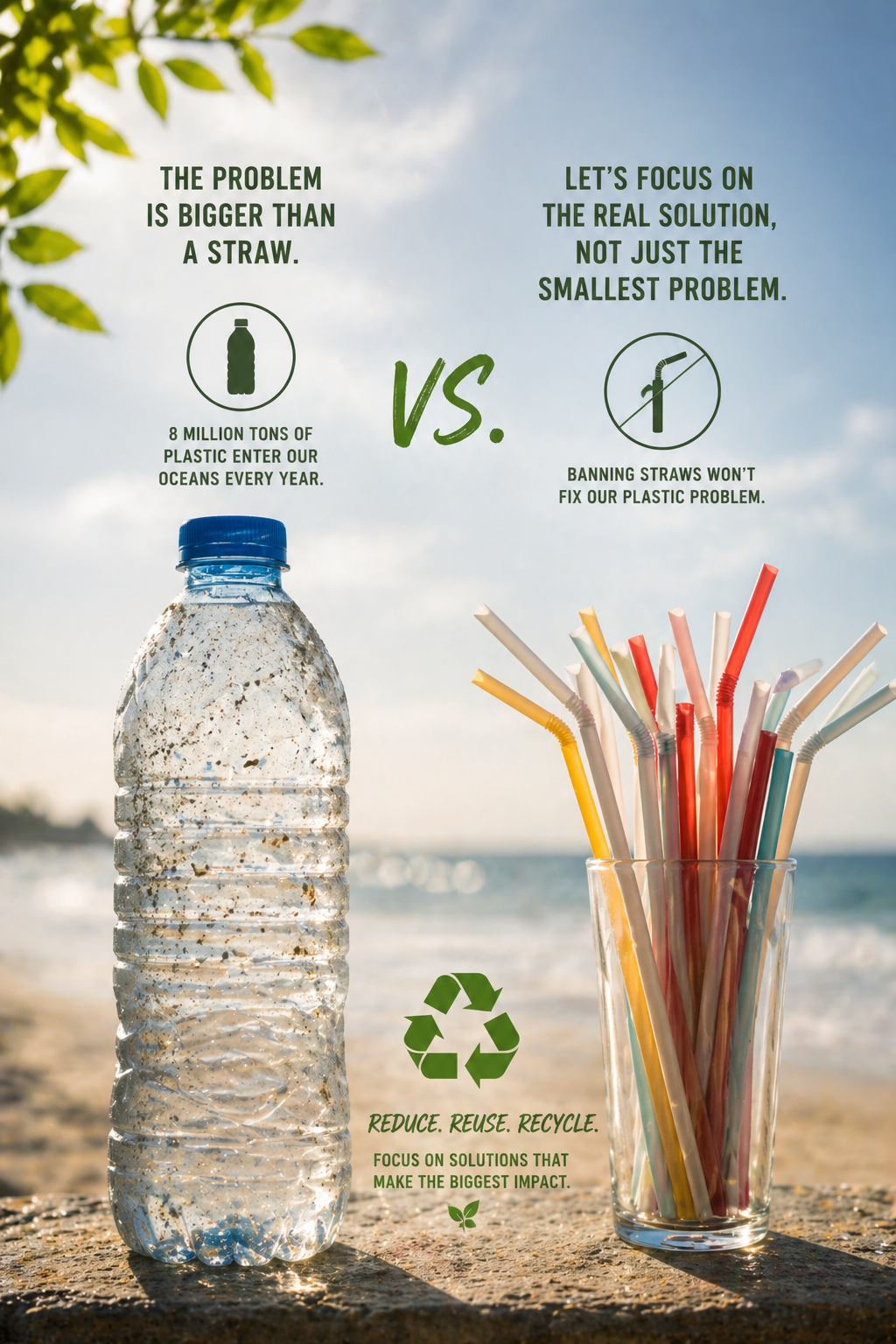
I say all this up front because I want you to understand something before the rest of this article lights people on fire: I actually want the bottle ban. I want single-use plastic production taxed into oblivion. I want deposit systems on every drink container in the country. I want the oceans to stop filling up with garbage. I think continuing to dump eight million tons of plastic into the water every year is a civilizational embarrassment we will not be forgiven for. I want real action, and I want it now, and I want it to hurt, because that is the only kind of action that works.
That is why the plastic straw war makes me want to throw things.
Not because plastic pollution isn’t real. It’s catastrophically real. Microplastics are in our blood, our lungs, our testicles, our tap water. Half of all plastic ever produced was made in the last twenty years, and nearly half of that was designed to be used once and thrown away. The ocean is choking and the land isn’t far behind it.
The straw war makes me furious because the straw is not the problem. The straw was never the problem. And the people waving the straw around knew it the whole time. They ran a decade-long campaign against one of the smallest, most peripheral pieces of plastic in the entire waste stream specifically because it let them look like they were doing something while making sure nothing actually got done. They burned ten years of public attention, billions of dollars of donor money, and every ounce of the political will a frightened public was ready to spend — and they spent it on a straw. And if we’d spent any of it on the real targets, we might actually be somewhere by now.
They stole the decade. That’s the part that makes me angry. Not the ban. The theft.
The Number They Don’t Print on the Poster
Plastic straws make up 0.025 percent of the plastic that flows into the ocean each year.
That is not a typo. That is not a quarter of a percent. That is twenty-five thousandths of a percent. For every ten thousand pounds of plastic entering the ocean, straws account for two and a half pounds. You could eliminate every plastic straw on Earth tomorrow and the oceans wouldn’t notice. A rounding error would notice more.
Meanwhile: Americans buy about 50 billion plastic water bottles a year. Globally, 500 billion. That’s 66 bottles per year for every human being on the planet, including babies and Amish people. The United States alone cranks out roughly 80 million tons of plastic packaging waste every year. Each bottle lasts about 450 years in seawater, grinding itself down into the microplastic dust we’re now inhaling and feeding to our children.
Almost half of all plastic produced worldwide is single-use. Bottles. Bags. Clamshells. Shrink wrap. The cup. The lid on the cup. The sleeve on the lid. The little plastic stopper in the sleeve. The straw — yes, one of the smallest, lightest, most peripheral items in the entire plastic supply chain, dwarfed by every piece of packaging it ever came wrapped in.
If you actually wanted to reduce single-use plastic pollution, you would not start with straws. You would start with bottles. You would start anywhere but straws.
They started with straws. Ask why.
Why They Picked the Smallest Target on the Field
Here’s the origin story, and it is genuinely this dumb.
In 2011, a nine-year-old in Vermont called some straw manufacturers and came up with an estimate that Americans throw out 500 million plastic straws a day. Later research put the real number between 170 and 390 million, but the kid’s guess was the one that stuck, because it was the scariest, and because nobody in environmental journalism has ever once checked a number they liked. It ran in the New York Times, the Washington Post, CNN, National Geographic, on and on, for a decade. A child’s phone survey became the statistical backbone of a global movement.
Then in 2015, a marine biologist off Costa Rica filmed her team extracting a four-inch plastic straw from an olive ridley sea turtle’s nostril. The video runs eight excruciating minutes. The turtle bleeds. It’s been watched more than 110 million times. After that, the straw was finished.
Seattle banned them in 2018. Starbucks, American Airlines, Disney, Hyatt folded within weeks. California, New York, New Jersey, Oregon, Washington, Delaware, Rhode Island passed laws. Paper straws showed up in every fast food restaurant in America, and they were terrible. They are still terrible. They collapse in your iced coffee like a wet napkin and taste like the inside of a cardboard box, which is exactly what they are.
Here is the part they’ll admit if you push. The people running the campaign knew straws weren’t the real target. Lonely Whale, the nonprofit that led the US push, said on the record that their “straw campaign is not really about straws. It’s about pointing out how prevalent single-use plastics are in our lives.” Jackie Nuñez, who started the Last Plastic Straw in 2009, called it a “gateway” issue — small, easy, emotionally charged, a way to get people thinking about the real problem.
So let’s be clear about what that means. The plan was always to start with the thing that didn’t matter, get the public to give it up, and then ride the momentum into the thing that did matter.
They got the first half. They never intended to do the second half. And the reason they never intended to do the second half is the whole point of this article.
The Forbidden Reckoning
This is the same pattern I traced through the solar subsidy racket. Every time you look closely at a “green” policy, you find the same structural logic underneath: the costs get socialized, the virtue gets privatized, and the people writing the rules make sure their own consumption habits never appear on the target list. The ask always flows downhill. The sacrifice always lands on someone who wasn’t in the room.
Now apply it to plastic.
A straw ban inconveniences the little people. Working-class diner customer wants a straw with her Coke, now she gets a paper one that dissolves in ninety seconds. Trucker at the Love’s wants a lid for his 44-ounce fountain Mountain Dew, now the straw’s an afterthought he has to ask for. Disabled kid needs a bendable plastic straw to drink without choking, now she has to carry her own and get interrogated by a waitress about whether she “looks disabled enough.” Inconvenient. Annoying. Paternalistic. But cheap. Nobody’s household budget moved by a dollar. Nobody has to rethink anything about their life.
Now imagine banning single-use plastic water bottles the same way.
The $1 Aquafina at the 7-Eleven becomes a $6 glass bottle. The $2 Gatorade at the gym becomes an $8 aluminum canister. The case of Poland Spring from Costco that gets a family through a week of sports practices goes from $4 to $25, or stops existing entirely. Every truck stop, every vending machine, every concession stand, every hotel mini-fridge, every airport kiosk — every place an ordinary person grabs a cheap drink without thinking — suddenly costs five to ten times more overnight.
Watch what happens in that country.
The average American would be furious. Not mildly put out, not inconvenienced — furious. And within about forty-eight hours, the average American would have to do something nobody in our political class actually wants them to do: perform an honest audit of how much they personally care about the environment when the price tag shows up at the register.
A lot of people would discover, uncomfortably, that the answer is not enough to pay six dollars for water.
And that answer — that quiet, working-class, kitchen-table answer — is the most dangerous sentence in American environmental politics. Because the moment a regular person says it out loud, the entire premise of the last thirty years of green rhetoric collapses. The premise has always been that everyone cares, that everyone agrees, that only malice or ignorance or oil money explains resistance. A bottled water ban would reveal, on national television, at every gas station in the country, that most people’s environmentalism has a price ceiling and that ceiling is about two dollars.
The rich cannot allow that reckoning to happen. Because if the poor and the middle are forced to admit that they won’t pay real money to save the ocean, then the rich have to admit it too — and the rich have built their entire moral identity on the fiction that they would. The $6 Fiji on the yoga studio counter exists precisely because it lets the woman holding it signal that she is the kind of person who pays extra. Making bottled water universally expensive strips the signal. If everyone’s water costs six dollars, nobody is special for buying six-dollar water. The status collapses. The costume comes off.
So the ban never happens. Not because it wouldn’t work — it would work enormously, it would dwarf every other plastic intervention combined — but because running the experiment would expose two things the rich liberal professional class cannot survive having exposed. One, that their own environmentalism is mostly a consumption aesthetic. Two, that the working class they claim to speak for does not, in fact, share their priorities when forced to put skin in the game.
The straw is the compromise. The straw is the thing they can ban without anyone having to find out anything true about themselves. The little people lose a minor convenience. The rich keep their Fiji. The ocean keeps filling with bottles. Everybody walks away feeling exactly as virtuous as they did before, which is the only outcome the people in charge of the conversation were ever going to accept.
That’s the con. The straw isn’t just a small target. The straw is a safe target — safe because it doesn’t force anyone to learn anything about themselves or anyone else. And a safe target, in the middle of a civilizational crisis, is just a different kind of crime.
Moral Licensing, or: The Gold Star Economy
Behavioral psychologists have a name for the other half of the trick. It’s called moral licensing. Do one virtuous thing, and the brain hands you a coupon for something less virtuous later. Recycle at home, feel great about the weekend flight to Cabo. Drive a Prius, feel great about the second home. Refuse the straw, feel great about the case of Dasani in the trunk.
Even Stanford’s Jim Leape, who runs the Center for Ocean Solutions, tried to warn people at the peak of the straw panic. Banning straws, he said, “may confer moral license — allowing companies and their customers to feel they have done their part.” Academic research has confirmed it over and over. Perform one pro-environmental behavior and you become less likely to perform the next one, not more. People who think they’ve been good give themselves permission to stop being good.
This is not an accidental feature of the straw ban. This is the product. The entire business model of professional-class environmentalism is manufacturing gold stars. Somebody has to design the gesture that lets the donor class feel moral without costing them anything. Somebody has to stage the public ritual of sacrifice that isn’t actually a sacrifice. Somebody has to keep the donations flowing by producing measurable “wins” that don’t threaten any donor’s lifestyle.
The straw was perfect. It was designed to be perfect. A visible target. An easy pledge. A hashtag. A corporate partnership. A nonprofit sector fed for a decade on the illusion of progress.
Hong Kong cut plastic straw consumption 40 percent between 2017 and 2020. Total plastic waste in the same window went up 10 percent. Straws went down, bottles went up, packaging went up, everything else went up, and everybody in the NGO sector put out press releases about what a win it was. That’s the game. That is the entire game. And the planet paid for it.
Who Gets Hurt, and Who Gets to Watch
The disabled community caught it before almost anyone else. People with muscular dystrophy, cerebral palsy, ALS, quadriplegia — people for whom a bendable plastic straw is not a convenience but the difference between drinking and aspirating fluid into their lungs — watched the bans get written without anyone bothering to ask them a single question. Metal burns. Paper collapses. Glass breaks. Silicone can’t be sanitized on the road. They said so from day one, loudly, and the movement told them to shut up and suck it up for the turtles. A waitress once denied a straw to a woman with a joint condition because the woman didn’t “look disabled enough.” That is the energy we’re talking about. Happy to interrogate a stranger in a restaurant over a piece of plastic that weighs less than a paperclip. Not willing to look at the forty-pound case of bottled water on the counter behind her.
This is the actual through-line of the last decade of progressive environmentalism. The poor and the disabled eat the costs. The rich keep the Fiji. The costs get socialized. The virtue gets hoarded. The ask always flows downhill and the sacrifice always lands somewhere else.
Nestlé Waters pumped groundwater out of California during the worst drought in the state’s modern history to bottle and sell back to Californians at a 2,000 percent markup — while writing checks to plastic-reduction nonprofits. Coca-Cola produces about three million tons of plastic packaging a year and also funds ocean cleanup charities. The industry bought the movement. The movement went after straws. The people running both sides of the transaction drink bottled water at every meeting.
What Should Actually Happen
I want to be clear about something because I know what the reflexive reading of an article like this looks like. Some of you are going to close this tab thinking I’m saying the whole thing is fake, the environment is fine, bans are bad, deregulation is the answer.
That’s not the argument. That’s the opposite of the argument.
The argument is that we should have done the real thing, and we didn’t, and the reason we didn’t is that the people supposedly in charge of doing it made sure we couldn’t. And we are running out of time.
Here’s what the real thing looks like.
Tax single-use plastic at the production line, not at the checkout counter. Make Coca-Cola pay a cent for every gram of virgin PET they put into the waste stream. Watch the price of a bottle of water quietly rise. Watch refillable glass and aluminum come roaring back — we used them for a century before the bottling industry switched to PET in the 1970s because it was cheaper for them, not better for anyone else. The infrastructure existed. We tore it out. We can build it back.
Deposit systems work. Germany hits 98 percent return rates on bottles because it costs you real money to not return one. Michigan has done it since 1976. Ten other states do some version of it. It is not hard. It is not theoretical. It just requires the political class to be willing to inconvenience the bottling industry, which the political class has spent fifty years being bought by.
Extended producer responsibility laws — making the company that manufactured the packaging pay for the end-of-life cost of that packaging — work everywhere they’ve been tried. France, Germany, South Korea, most of the EU. They shift the incentive where it belongs: onto the people who profit from the packaging, not the people who happen to buy the drink inside it.
Ban a specific list of genuinely gratuitous single-use items — polystyrene takeout containers, lid collars, the shrink wrap around bottled water cases that is itself plastic around more plastic. Fund industrial composting infrastructure so the biodegradable claims actually become true instead of being a lie told on the side of a cup. Put real resources into fishing gear retrieval, which is the single biggest piece of ocean plastic by weight, because it turns out international industrial fishing fleets don’t respond to yoga studio boycotts.
And require disability-accessible alternatives in every single one of those policies, by law, on the first day. Not as an afterthought. Not as a hardship exception you have to beg for. On day one, in the statute, with teeth.
None of that is radical. Most of it is boring. All of it would work. And none of it is on the table, because all of it would raise the price of a Fiji and expose the costume.
So yes — pass the real bans. Do the hard thing. Make people uncomfortable at the register. Let the working class, the middle class, the rich, and every nonprofit executive director find out at the same register, on the same day, how much they actually care about the ocean when their own wallet is the one being asked. Let the reckoning happen.
Some people will fail the test. That’s fine. That is useful information. A country that knows what it actually values can have an honest conversation about it. A country that is being lied to about what it values cannot.
The Ocean Does Not Know
So we got a decade of straws instead. We got paper straws that dissolve before your drink is half gone. We got metal straws people bought in little fabric sleeves, used twice, and forgot on their nightstands. We got a 2025 executive order reversing the whole thing because the President doesn’t like paper straws either, which is somehow the most honest moment in the entire ten-year saga. We got a generation of people who genuinely believe they helped save the ocean by refusing a straw at Applebee’s.
The ocean does not know they refused the straw. The ocean is still full of bottles. Their bottles. The ones they will never, under any circumstances, agree to give up, because the moment those bottles get expensive, the whole country finds out what environmentalism is actually worth to the average American — and, more quietly, what it was actually worth to the rich people who spent a decade pretending to lead the charge.
I’ll keep doing what I do. Driving the old trucks until they die. Saving the wood, the metal, the twine off the bales. Fixing what breaks instead of replacing it. It matters, a little. Individual virtue always matters a little. But the fix is not individual. The fix is structural, and expensive, and politically difficult, and it has to cost somebody real money before it does anything real. That’s the whole point. That’s what makes it work.
The next time someone lectures you about a plastic straw while holding a twenty-ounce Aquafina, smile politely and remember what you’re actually looking at. Not an environmentalist. A person who paid six dollars for tap water and wants you to think the problem is your coffee.
The straw was never the problem. The problem is sitting in their fridge. The problem is the $6 Fiji they’re sipping while they explain to you why your drink is killing the planet. The problem is the reckoning they have spent ten years — and a billion dollars of donor money — making sure nobody ever has to face.
I want that reckoning. I want it badly. I want it because I want the ocean back, and I want the hay bale twine recycled, and I want my kids’ kids to live on a planet that is not a garbage dump, and I know — everyone paying attention knows — that the only way any of that happens is if we stop playing dress-up with straws and do the real thing.
Start there. Or admit, finally, that you were never going to start at all.
References
The 0.03 percent figure and the 8 million tons of plastic in the ocean
Adam Minter, “Plastic Straws Aren’t the Problem,” Bloomberg Opinion, June 7, 2018. https://www.bloomberg.com/opinion/articles/2018-06-07/plastic-straws-aren-t-the-problem
Brigit Katz, “Starbucks Vows to Ditch Plastic Straws by 2020,” Smithsonian Magazine, July 9, 2018. https://www.smithsonianmag.com/smart-news/starbucks-vows-ditch-plastic-straws-2020-180969573/
Milo Cress and the 500 million figure
Mira Cheng, “One Child’s Outsized Influence On The Debate Over Plastic Straws,” NPR, July 22, 2018. https://www.npr.org/2018/07/22/631254978/one-childs-outsized-influence-on-the-debate-over-plastic-waste
Allyson Chiu, “This Kid Single-Handedly Ignited the Plastic Straw Ban Movement,” The Daily Beast, 2019. https://www.thedailybeast.com/this-kid-single-handedly-launched-the-plastic-straw-ban-movement/
The 170M–390M counter-estimates
Tim Brinkhof, “Straw Ban Arguments,” Tablet Magazine (citing Technomic and Freedonia Group). https://www.tabletmag.com/sections/news/articles/straw-ban-arguments
Zahra Hirji, “The First Plastic Straw Poll,” BuzzFeed News, August 26, 2018. https://www.buzzfeednews.com/article/zahrahirji/plastic-straw-poll
Christine Figgener and the sea turtle video
Christine Figgener Wikipedia entry. https://en.wikipedia.org/wiki/Christine_Figgener
“How Did A Sea Turtle Get a Straw Up Its Nose?” National Geographic, August 2015. https://www.nationalgeographic.com/animals/article/150817-sea-turtles-olive-ridley-marine-debris-ocean-animals-science
Lindsay Fendt, “Researchers remove plastic straw from sea turtle’s nose,” Tico Times, August 18, 2015. https://ticotimes.net/2015/08/18/watch-researchers-remove-plastic-straw-from-sea-turtles-nose
Dune Ives / Lonely Whale “not really about straws” quote
Originally to Radhika Viswanathan at Vox; cited in Brigit Katz, “Starbucks Vows to Ditch Plastic Straws by 2020,” Smithsonian Magazine, July 9, 2018.
“The Anti-Plastic-Straw Phenomenon,” Earth.Org, 2020. https://earth.org/data_visualization/the-anti-plastic-straw-phenomenon/
Jackie Nuñez “It was never about the straw” quote and the 2009 founding date
Julia Simon, “Trump says ‘we’re going back to plastic straws.’ Is the paper straw dead?” NPR / WYPR, February 11, 2025. https://www.wypr.org/2025-02-11/trump-says-were-going-back-to-plastic-straws-is-the-paper-straw-dead
Jim Leape “moral license” quote
Rob Jordan, “Last straw: The path to reducing plastic pollution,” Stanford Report, September 2018. https://news.stanford.edu/stories/2018/09/last-straw-path-reducing-plastic-pollution
Hong Kong: 40 percent drop in straws, 10 percent rise in plastic waste
“OPCFHK Survey Shows Plastic Straw Consumption in Hong Kong Reduced by 40 Percent over Past Three Years,” Ocean Park Conservation Foundation Hong Kong, June 10, 2020. https://www.opcf.org.hk/en/press-release/opcfhk-survey-shows-plastic-straw-consumption-in-hong-kong-reduced-by-40-percent-over-past-three-years
“The Anti-Plastic-Straw Phenomenon,” Earth.Org. https://earth.org/data_visualization/the-anti-plastic-straw-phenomenon/
Disabled community pushback and the “look disabled enough” incident
Anna Quinlan, “Viral Tweet Thread Shows How Straw Bans Harm Disabled People,” The Mighty, June 2019. https://themighty.com/2019/06/tweet-thread-straw-bans-disability/
A. Pawlowski, “Plastic straw bans hurt kids and adults with disabilities, advocates say,” Today, July 2018. https://www.today.com/health/plastic-straw-bans-hurt-kids-adults-disabilities-advocates-say-t158808
Maya Salam, “‘Disabled People Are Not Part of the Conversation.’ Advocates Speak Out Against Plastic Straw Bans,” Time, July 2018. https://time.com/5335955/plastic-straws-disabled/
Maria Godoy, “Why People With Disabilities Want Bans On Plastic Straws To Be More Flexible,” NPR, July 11, 2018. https://www.npr.org/sections/thesalt/2018/07/11/627773979/why-people-with-disabilities-want-bans-on-plastic-straws-to-be-more-flexible
46 percent of the Great Pacific Garbage Patch is fishing gear
L. Lebreton et al., “Evidence that the Great Pacific Garbage Patch is rapidly accumulating plastic,” Scientific Reports, March 2018, summarized by Adam Minter for Bloomberg.
Coca-Cola plastic packaging output (~3 million tons/year, 200,000 bottles/minute)
Sandra Laville, “Coca-Cola admits it produces 3m tonnes of plastic packaging a year,” The Guardian, March 14, 2019.
Marina Pitofsky, “Coca-Cola reveals that it produces 3.3M tons of plastic packaging annually,” The Hill, March 15, 2019. https://thehill.com/policy/energy-environment/434017-coca-cola-reveals-that-it-produces-33m-tons-of-plastic-packaging/
Oceana, “Coca-Cola and Pepsi’s plastic packaging use increases by hundreds of millions of pounds,” March 11, 2025. https://oceana.org/press-releases/oceana-coca-cola-and-pepsis-plastic-packaging-use-increases-by-hundreds-of-millions-of-pounds/
Coca-Cola funding ocean cleanup partnerships
“The Ocean Cleanup and The Coca-Cola Company Announce Partnership,” The Ocean Cleanup press release, June 2, 2021. https://theoceancleanup.com/press/press-releases/the-ocean-cleanup-and-the-coca-cola-company-announce-partnership/
“The Coca-Cola Foundation Grants $1 Million to The Recycling Partnership,” The Recycling Partnership press release, June 4, 2018. https://recyclingpartnership.org/the-coca-cola-foundation-grants-1-million-to-the-recycling-partnership-to-help-prevent-marine-debris-at-the-curb/
Nestlé California groundwater extraction during the drought
Bill Chappell, “California Says Nestle Lacks Permits To Extract Millions Of Gallons Of Water,” NPR, December 27, 2017. https://www.npr.org/sections/thetwo-way/2017/12/27/573774328/california-says-nestle-lacks-permits-to-extract-millions-of-gallons-of-water
Ian James, “Bottling water without scrutiny,” Desert Sun, March 8, 2015 (the original investigation).
Trump Executive Order 14208 (February 10, 2025)
Executive Order 14208, “Ending Procurement and Forced Use of Paper Straws,” The White House, February 10, 2025. https://www.whitehouse.gov/presidential-actions/2025/02/ending-procurement-and-forced-use-of-paper-straws/
Julia Simon, NPR, February 11, 2025 (cited above).
State-level straw laws (CA, NY, NJ, OR, WA, DE, RI)
Julia Simon, NPR, February 11, 2025 (cited above).
Germany 98 percent return rate and deposit-system precedents
Various reports on the German Pfand deposit system; baseline return rate widely reported in OECD and Reloop Platform analyses.
Microplastics in human blood, lungs, testicles, and tap water
Heather A. Leslie et al., “Discovery and quantification of plastic particle pollution in human blood,” Environment International, 2022.
Lauren C. Jenner et al., “Detection of microplastics in human lung tissue,” Science of The Total Environment, 2022.
Xiaozhong Hu et al., “Microplastic presence in dog and human testis,” Toxicological Sciences, 2024.
Sherri A. Mason et al., “Synthetic Polymer Contamination in Bottled Water,” Frontiers in Chemistry, 2018.