Recently, something floated across my feed from a C-level executive confidently declaring that no, AI is not coming for your job.
I didn’t bother reading the article.
Not because the topic isn’t important—but because I’m already waist-deep in AI. I use it daily. I rely on it in professional workflows. I build personal systems around it. I don’t need a motivational LinkedIn post to tell me what’s real and what isn’t.
So let’s talk about the counterpoint. Let’s talk about why AI absolutely is coming for your job—and why corporate America is uniquely motivated to make that happen.
Labor Is the Leak—Always Has Been
In most companies, labor is the single largest cost center. Full stop.
And if there is one immutable truth in corporate America, it’s this: Anything that looks like labor will eventually be reduced, outsourced, automated, or eliminated.
Companies don’t have loyalty to roles. Or people. Or institutional knowledge. They have loyalty to margins.
If a company could replace a skilled worker with a cheaper one, they would. If they could replace a cheaper worker with an even cheaper one, they would. And if—hypothetically—they could replace you with a child on a bicycle powering a laptop for a dollar a day?
They wouldn’t lose sleep over it.
That’s not cynicism. That’s precedent.
Enter the Shiny New Toy
AI is the latest “shiny object” that promises to reduce labor costs. And if you’ve spent any time in tech—or frankly, any large organization—you already know how this plays out.
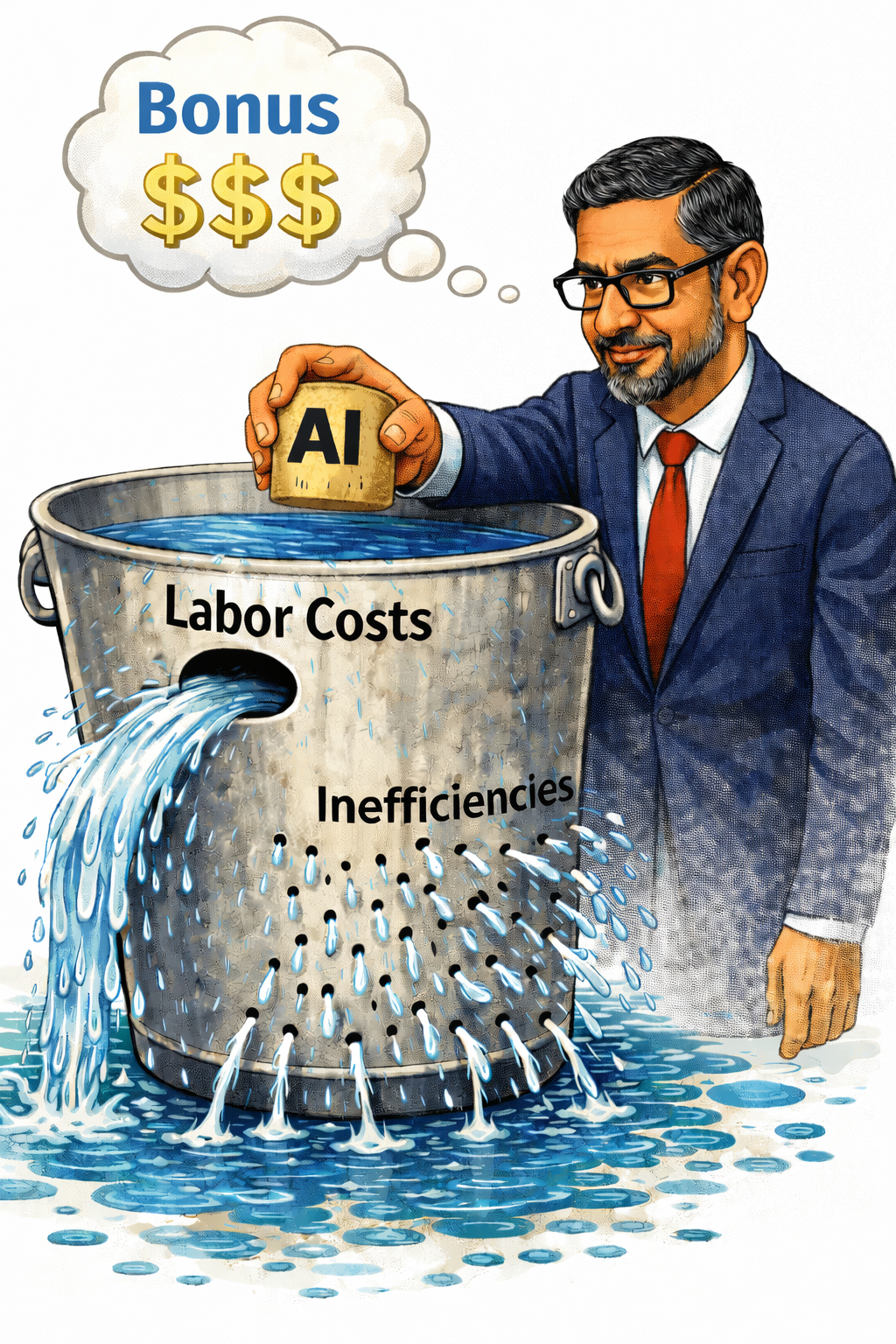
The C-suite sees a leak. They label it “labor cost.” And they decide the solution is to plug that leak with AI.
There’s even a perfect mental image for it: A CEO staring at a bucket labeled Labor, watching money pour out of a hole, and enthusiastically jamming an “AI” cork into it.
Problem solved. Right?
Not quite.
The Leaks They Won’t Fix
Here’s the part that rarely gets discussed.
Most companies are hemorrhaging money through thousands of small operational inefficiencies—manual processes, brittle workflows, duct-taped spreadsheets, repetitive reporting tasks.
Take a simple example:
Someone pulls data from a database once a week. Exports it to CSV. Opens Excel. Builds a chart. Pastes it into a slide deck.
Two hours. Every week. Like clockwork.
Now ask a C-level executive what it would take to automate that.
- An IT resource
- Possibly a DBA
- Testing
- Maintenance
- Three months of effort
Suddenly, labor costs go up before they go down.
And the ROI?
“John spends two hours a week on it.”
That’s it. Not compelling. Not headline-worthy. Not bonus-eligible.
Multiply that inefficiency by a thousand processes across the organization, and you have death by a thousand cuts. But no executive gets applause for fixing those cuts.
Imagine an earnings call where a CEO announces:
“This quarter, we identified 1,000 operational inefficiencies and fixed 125 of them, saving $200,000 annually.”
They’d be laughed off the stage.
Why AI Wins (Even When It Shouldn’t)
AI doesn’t suffer from that problem.
AI can be pitched as:
- Transformational
- Strategic
- Disruptive
- Visionary
It’s big. It’s visible. It’s something executives can put their name on.
More importantly, it aligns perfectly with the only two things most C-level executives are actually incentivized by:
- Salary
- Bonus
Not people. Not long-term organizational health. Not sustainable efficiency.
If an executive launches an AI initiative, gets it “off the ground,” and it sort of works, they win. They either:
- Move on to the next company for more money, or
- Collect a bonus for having championed the shiny new thing
The downstream consequences don’t matter. They’re someone else’s problem.
“But Not All Companies…”
Correct.
Privately held firms can be different. Owner-operators sometimes think longer-term. Incentives can align more closely with reality.
But in corporate America, this pattern is depressingly consistent.
Which brings us back to the comforting myth:
“AI can’t replace me.”
It already is.
I personally know people—right now—who have lost their jobs to AI-based solutions. Not hypothetically. Not eventually. Already.
And as AI improves, accelerates, and gets cheaper, that trend won’t slow down.
So Now What?
If you believe AI isn’t coming for your job because a C-level executive said so, you’re trusting the same people who:
- Routinely chase the wrong efficiencies
- Optimize for optics over outcomes
- Are structurally rewarded for short-term wins
Maybe I’m being harsh. Maybe this is a knee-jerk reaction.
But if your experience in corporate America tells a different story, I genuinely want to hear it.
Are executives really incentivized to protect workers? Have you seen AI not replace roles once it became “good enough”? Or are we all just pretending this isn’t happening yet?
Because from where I’m standing, the writing isn’t just on the wall—it’s already in production.